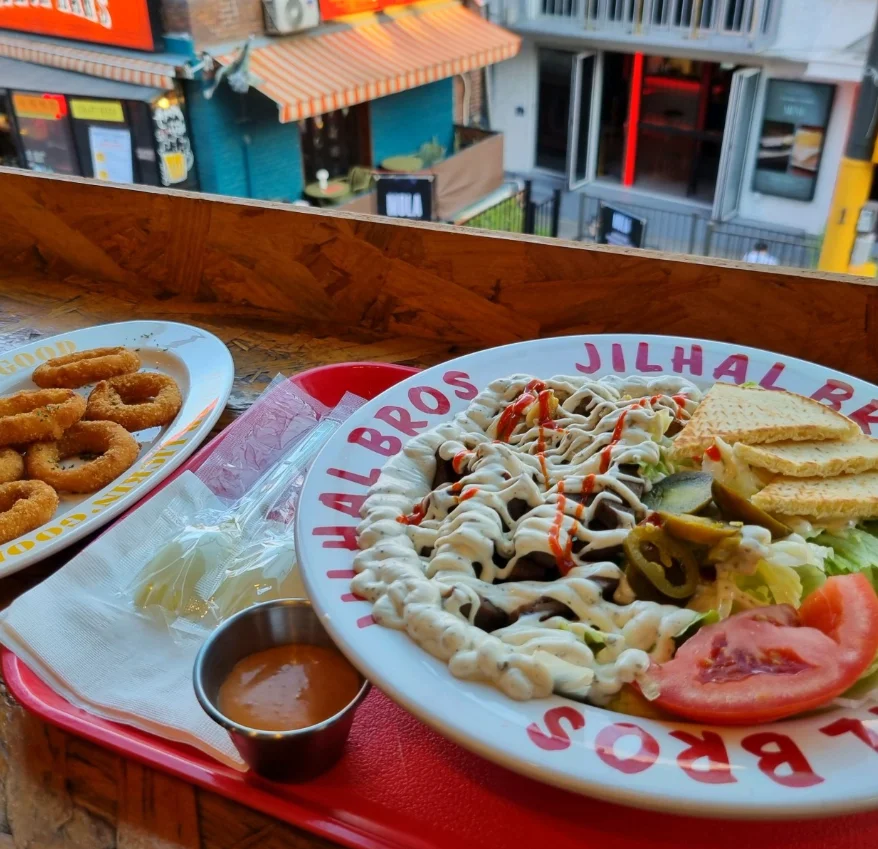
Halal Food Delivery in Seoul: Why You're Stuck in Itaewon (And How to Get Out)
760,000 Muslim tourists visited Korea in 2023 — but Seoul has only 122 halal restaurants, and most won't deliver outside Itaewon. Here's why the information, the delivery radius, and the Korean-language verification all fail you, and what actually works.
An Indonesian couple visiting Gyeongbokgung Palace told us the same thing we hear every week: "Every time we search for halal food on Instagram, everything is in Itaewon. So we go to Itaewon for dinner. Every night." They were staying in Myeongdong — twenty minutes away by taxi, forty by subway. Every night, for a week.
This is not a coincidence. It is a structural problem. Halal restaurants exist in Seoul beyond Itaewon. But the information doesn't, the delivery doesn't, and the Korean-language verification definitely doesn't — not for a tourist visiting on a foreign SIM with no Korean.
The Numbers: 760,000 Visitors, 122 Restaurants
In 2022, 359,000 Muslim tourists visited Korea. In 2023, that number jumped to 760,000 — more than doubling in a single year. Muslim travelers now account for approximately 11% of all foreign visitors to the country, according to Korea Tourism Organization (KTO) data.
On the supply side: Seoul has roughly 820,000 registered restaurants. Of those, 122 are halal-certified. That is 0.01%. Nationwide, the number reaches 278.
The gap between those two figures — demand growing at double-digit annual rates, supply measured in the hundredths of a percent — is where the Itaewon clustering comes from. It is not that Muslim travelers want to go to Itaewon every night. It is that the information ecosystem points there, and nowhere else.
KTO surveys have rated "food" as the single most important area for improvement cited by Muslim visitors to Korea — in 2016, 2018, and 2019, three years running. The Mastercard Muslim Travel Index scores Korea's halal food experience at 42 out of 100. Singapore scores 90.
Why You Can't Find Halal Food: The Information Problem
There is no well-maintained, accurate, English-language official directory of halal restaurants in Korea. The Korea Tourism Organization publishes a list, but it is difficult to navigate by neighborhood or cuisine, and it includes more than 20 restaurants that have since closed. Searching it produces results that no longer exist.
Unofficial lists and travel blog posts fill some of the gap, but they go out of date quickly. A restaurant that was halal-certified last year may have let its certification lapse. A new halal-friendly restaurant that opened three months ago may not appear anywhere in English-language search results for months.
The 81.1% figure matters here: KTO surveys found that Muslim visitors choose halal food for 81.1% of their meals in Korea. That is not a niche preference — it is a near-total dietary requirement for a population that numbered 760,000 last year. When the information infrastructure fails at that scale, the result is what happens every evening at Itaewon.
Even When You Find a Halal Restaurant, It Won't Deliver to Your Hotel
Suppose you do manage to locate a halal-certified restaurant that is not in Itaewon. The next problem: delivery.
Korean food delivery apps — Baemin and Coupang Eats — have delivery radius limits set by each restaurant. A halal restaurant in Itaewon typically covers Itaewon and the immediate surrounding area. It does not cover Gangnam, Hongdae, Myeongdong, or most other neighborhoods where tourists actually stay.
This is not a workaround problem. You cannot tip the driver more. You cannot find a different app. The restaurant simply does not deliver to your address, and there is no mechanism within the standard app ecosystem to bridge that gap.
There is also the registration barrier: both Baemin and Coupang Eats require a Korean phone number to create an account. A tourist on a foreign SIM cannot register. Even if a halal restaurant in range existed, you could not place the order yourself.
Even When You Can Order, Verifying Halal Requires a Korean Phone Call
The third layer of the problem is verification. Halal certification in Korea is voluntary. Some restaurants are certified by the Korea Muslim Federation (KMF). Many restaurants that could be compatible with halal requirements — no pork, no alcohol in cooking — have never applied for certification and never appear on any list.
The only reliable way to confirm whether a specific dish at a specific restaurant meets halal requirements is to call the restaurant and ask in Korean. Questions like: Does the broth contain pork bone? Is there lard in the cooking oil? Are the utensils shared with pork dishes? Is any alcohol used in the marinade or sauce?
A tourist who does not speak Korean, calling a restaurant where no English is spoken, cannot get those answers. The app has no field for them. Google Maps reviews do not answer them. The restaurant's own website almost never answers them in English.
This is where the information gap becomes a food safety gap.
What DOWAME Does
DOWAME is a concierge service for foreign tourists in Seoul and Busan. For Muslim travelers specifically, the service works like this:
- Restaurant identification beyond Itaewon. We identify halal-certified restaurants and halal-compatible restaurants near your hotel — not just the Itaewon cluster, but options in Gangnam, Myeongdong, Hongdae, and elsewhere, based on your current location.
- Halal verification by phone in Korean. We call the restaurant before confirming your order and ask the specific questions that matter: broth ingredients, cooking oils, shared surfaces, alcohol in sauces. We pass the answers to you so you can make the decision — we confirm facts, not certifications.
- Delivery outside the normal radius. When a restaurant does not deliver to your hotel directly, we coordinate quick delivery or pickup arrangements that the standard apps cannot handle.
- No Korean phone number or Korean card required. We handle the order, the app, and the payment on your behalf. You tell us what you want; we take care of the rest.
Concierge support is available from 9 AM to midnight KST.
FAQ
Is there any app to order halal food in Korea?
No halal-specific food delivery app exists in Korea as of 2024. The major Korean delivery apps (Baemin, Coupang Eats) have no halal filter and require a Korean phone number to register — which most foreign visitors do not have. The most practical alternative is a concierge service that can identify halal-compatible restaurants, verify ingredients by phone in Korean, and place the order on your behalf.
Are there halal food options in Hongdae or Myeongdong?
Very limited options exist in both neighborhoods. Myeongdong has a small number of halal street food vendors and a handful of halal-certified restaurants. Hongdae has almost no certified halal options. In both areas, finding restaurants with halal-compatible menus requires local knowledge and Korean-language verification — the standard tourist search path (Instagram, Google Maps, travel blogs) is not reliable enough to count on.
Can I get halal Korean BBQ delivered?
Korean BBQ using halal-certified beef does exist in Seoul, primarily in Itaewon. Whether it can be delivered to your hotel depends on the restaurant's delivery radius and whether the restaurant delivers at all — many Korean BBQ restaurants are dine-in only. A concierge can identify which halal Korean BBQ options are near your hotel, confirm the meat sourcing and cooking arrangements, and arrange delivery or a reservation.
How do I know if a Korean restaurant is really halal?
The most reliable indicator is KMF (Korea Muslim Federation) certification, displayed as a sticker at the restaurant. Beyond that, there is no trustworthy shortcut. Restaurant listings online are frequently outdated. The only way to verify for a specific dish at a non-certified restaurant is to ask the restaurant directly — in Korean — about broth, oils, marinades, and shared cooking surfaces. If you cannot make that call yourself, a Korean-speaking concierge can do it for you before your order is placed.
Staying in Seoul and need halal food delivered to your hotel — outside Itaewon? DOWAME identifies halal-certified and halal-compatible restaurants near your location, verifies ingredients in Korean before confirming your order, and arranges delivery or pickup without requiring a Korean phone number or card. Available 9 AM to midnight KST.