Foreign card declined on a Korean website: what to try first
No, a decline on a Korean website usually does not mean anything is wrong with your card. Many Korean stores use payment systems built for domestic cards, so try the three checks below once each, and then stop before repeated attempts get the card blocked.
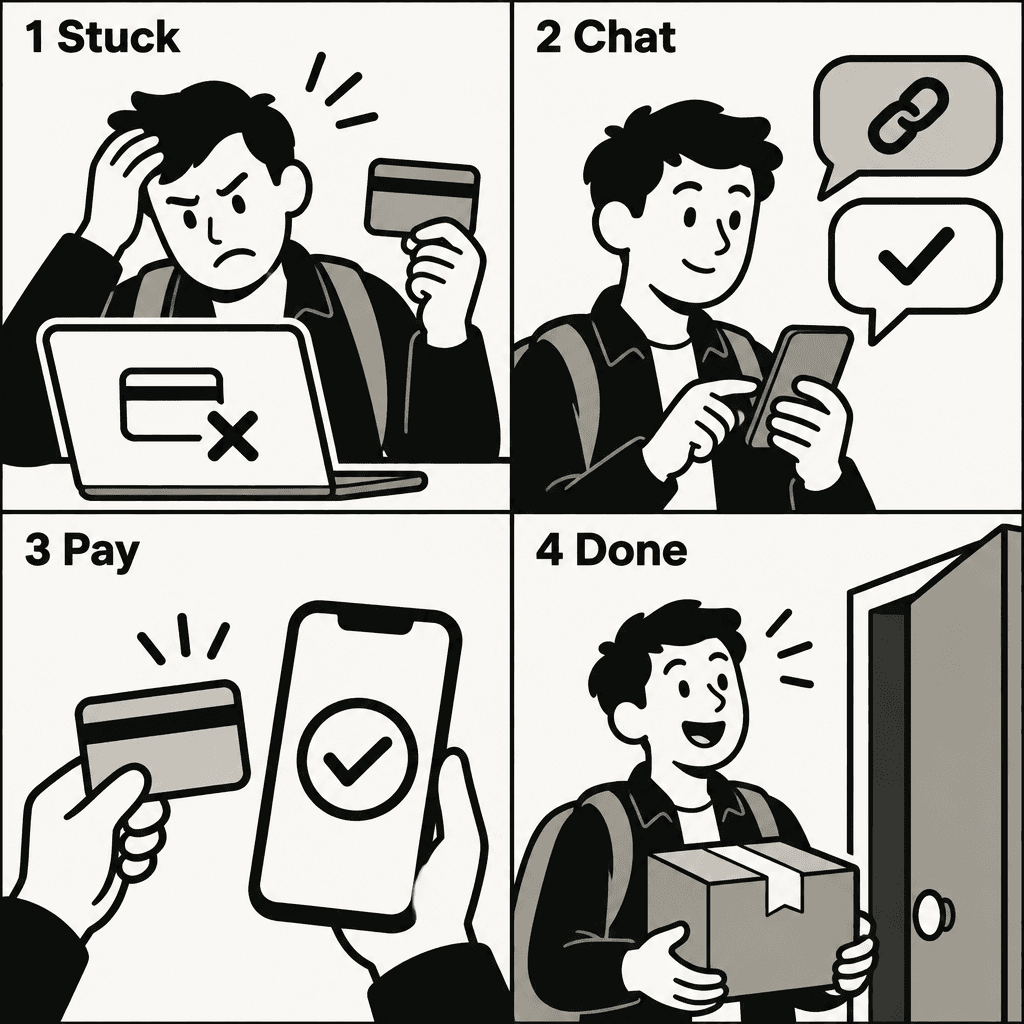
What you can do yourself
Try these in order. Do each one once. If a retry gives the same error, the next retry will too.
- Check for a block from your own bank. Open your banking app and look for a fraud alert or a decline notice. Turn on online and overseas purchases if they are off, and approve any security prompt. If your bank shows no attempt at all, the payment never reached it, and the problem is on the store's side.
- Look for a different way to pay on the same page. Some stores offer PayPal or a foreign card option separately from the main card form, often labelled as overseas or global payment. Look for it near the bottom of the payment list. Wallets linked to Korean bank accounts will not help you.
- Match your billing details and try a different card network. Enter your name and billing address exactly as your bank has them. If the store has a global checkout, use that. A different network, for example Mastercard instead of Visa, sometimes goes through where another did not.
While you try, watch where the failure happens, because it tells you which problem you have:
- The card form never loads, or only lists Korean card companies: the store takes domestic cards only. Nothing you do on your side will change this.
- The form accepts your number, then asks for a phone verification: the block is the Korean phone number, and it is covered in our ID verification guide.
- Your bank's security check appears and fails: ask your bank about it, or try another card.
- A generic Korean error appears after you submit: the payment was refused somewhere between the store and your bank. Try one more card, then stop.
Keep an eye on your statement. A failed payment can appear as a temporary hold and disappear by itself. If a charge is actually taken and no order is confirmed, contact the store and keep a screenshot.
Why this happens
Korean online payments grew up around Korean-issued cards, Korean phone numbers, and Korean identity checks. Foreign cards came later, and they were never made a requirement.
Stores choose domestic-only gateways
A store signs up with a payment gateway, and adding international cards is usually an extra contract with extra cost. Smaller sellers often do not bother. The Korea Times has reported that some merchants choose domestic-only setups because they are cheaper, and that some deliberately avoid foreign cards because of higher fees and slower settlement.
The checkout was designed for local identity
Many Korean card payments are linked to a local verification step, so even a site that displays a Visa logo can route you into a process your bank cannot complete. Error messages at that stage are often generic, and frequently only in Korean, so they tell you very little.
Why retrying makes it worse
Several failed attempts in a row look like fraud to your bank. It may freeze the card for your protection, which is the last thing you want in the middle of a trip. That is why the advice above is once each.
Billing address mismatches are a separate cause. Stores abroad may check the address on the card, and a hotel address in Korea will not match the one your bank has on file. Use your home billing address in the billing field, and keep the hotel for delivery only.
If you'd rather not deal with it
If those checks did not work, the order can still happen. Send us the product link and your hotel name. We buy with a Korean card and a Korean account and deliver to your hotel, or ship it abroad.
You pay us by PayPal, card, Wise, or Alipay. These run through systems built for international payments, so a card refused by a Korean store will normally work here. If it does not, you have other options and we will tell you what they are.
We reply within 30 minutes during service hours with one price and an arrival date. The service fee is from ₩8,000 per item. Delivery and card fees are shown in your quote before you pay.
This also applies to restaurants, salons, and ticket pages that refuse your card, and to QR payments that only accept Korean apps. If you are unsure, send a screenshot of the error.
A real case
A customer living in Seoul had no Korean phone number and could not buy from Coupang directly, so they sent us the product link and we sent a quote.
Their payment did not go through at first. When we offered to send the link again, they told us the link was not the problem. Their bank had stopped the charge to check that the person using the card overseas was really them. Once they confirmed that with the bank, the same payment went through.
We placed the order on our account, left the parcel at the door on their floor as they asked, and told them on KakaoTalk when it was there. If a payment stops once, check your bank's app or messages before you try a different card. A hold like this looks the same on screen as a refusal.
FAQ
Why does my card work in Korean shops but not on Korean websites?
In-person terminals are set up for international cards far more often than online checkouts are. Online, the store's choice of payment gateway decides, and many gateways handle domestic cards only.
Was I charged if the payment failed?
Usually not, but a temporary hold can appear on your statement and then drop off. If money actually leaves your account with no order confirmation, contact the store and keep a screenshot.
Will a prepaid travel card work?
Sometimes in stores, less often online. Prepaid cards face the same gateway limits, and some merchants reject them outright.