Korean ID verification won't pass: what tourists can do
No, a tourist usually cannot pass Korean phone identity verification, because it checks the mobile carrier's record of who owns the line and not just the number you type. Travel eSIMs and roaming numbers fail that check, so the realistic options are a service with its own passport route, a line registered in your name, or someone in Korea placing the order.
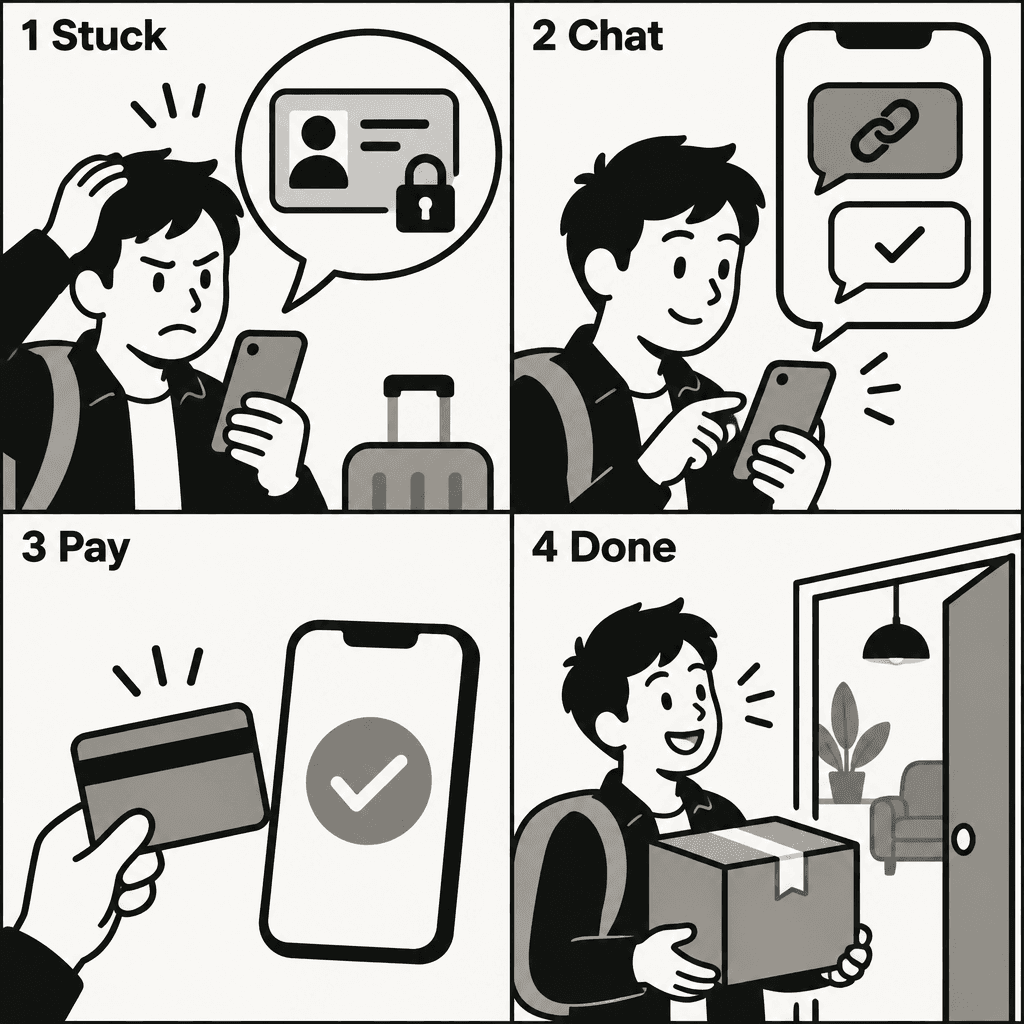
Why this happens
Korean websites use a step called phone identity verification, often shown as 본인인증. It is different from the text-message code you get on sites elsewhere. Here it asks you to pick your mobile carrier, then enter your name, date of birth, and a registration number, and it compares what you typed with the carrier's subscriber record.
Several things follow from that design, and they explain most of the failures people see.
- Receiving a text is not enough. A number can get messages and still fail, because the line has to be registered to the person verifying.
- A foreign or roaming number has no record at a Korean carrier.
- Data-only eSIMs have no number at all.
- A Korean prepaid SIM can be registered to your passport, but some services refuse prepaid lines. Coupang says so directly.
- The form may want a resident or alien registration number, and a visitor has neither.
- Name format matters. If a carrier holds your name in one form and you type another, the check fails with a generic message.
Sites use this check to meet age and fraud rules, and because sellers want a real person attached to each account. It is not aimed at foreigners, but that is the effect. It sits in front of shopping, secondhand apps, food delivery, ticketing, and restaurant booking.
What has changed recently
Korean services are slowly adding routes for visitors. Naver introduced passport verification for visitors that covers bookings, orders, and payments reached through Naver Map. Reports of a passport route on Coupang Eats exist, but we could not confirm one from Coupang itself. Treat any claim of this kind as something to recheck, including ours.
What you can do yourself
Start by working out which situation you are in.
If you are visiting
- Check if the service has a passport option. Look in the app's verification screen, or the help page, for "foreigner" or "passport".
- Look for a global version of the site. Some Korean retailers run one with an email sign-up and foreign card payment.
- Use apps aimed at visitors for maps, transport, and translation, as they generally do not ask for this check.
- Buy in person when you can. A store does not need to verify you.
If you are staying a while
- Open a Korean mobile line in your own name, ideally a postpaid plan. Bring your passport to the carrier's store, and ask whether the line can be used for identity verification.
- Once you have an alien registration card, register it with your carrier so your details match.
- Enter your name exactly as the carrier has it, including spaces and capital letters.
What to avoid
Do not buy "verified accounts", and do not pay a stranger to verify for you. Using someone else's identity for verification breaks the terms of nearly every Korean service, and it can cause legal problems for the person who lends it. Accounts created this way get closed, often with your order or balance still inside.
If a friend offers to help, the clean way is for your friend to place the order on their own account and pay, then you pay them back.
If you'd rather not deal with it
We do not lend our phone number and we do not open accounts in your name. What we do is simpler: you send the link, and we place the order ourselves, on our own account and with our own Korean card. You never have to pass the check, because the buyer is us.
It works for shopping sites, secondhand apps, tickets, and restaurant bookings that want a Korean number. We reply within 30 minutes during service hours with one price, and you pay only if you say yes. The service fee is from ₩8,000 per item. Delivery and card fees are shown in your quote before you pay.
There are limits. Anything that legally needs your own ID, such as a SIM card or a bank account, has to be done by you.
A real case
A foreign student in Seoul was still waiting for their Alien Registration Card and sent us links to items on Musinsa.
One item was only available in a single size, so we checked that with them before taking payment. At checkout, their foreign card would not accept a Korean address. We told them to leave their home billing address in that field, because it has nothing to do with where the parcel goes.
We placed the order on our own account, so the missing card never came into it. The parcel went to their building, they gave us the door code so the courier could get in, and we told them on WhatsApp when it was delivered. Nothing about the order required them to pretend to be a resident or to borrow anyone's details.
FAQ
Can a travel eSIM pass Korean identity verification?
Generally no. Most are data-only or registered outside the Korean carriers' records. The check needs a Korean line registered in your own name.
Does a Korean prepaid SIM work?
Sometimes. It can be registered to your passport, but some services, Coupang among them, refuse prepaid lines. Check the service's own help page before buying a SIM for this purpose.
Can I use a friend's number?
Not safely. The check compares that person's details, so you would be verifying as them. If your friend wants to help, they should order and pay on their own account.